
Governance
Governance at Bonneygrove and Millbrook Primary Federation
What is Governance?
At Bonneygrove and Millbrook Primary Federation, our Governing Body plays an important role in making sure that both of our schools are well led, safe, financially secure and continually improving.
As a Federation, Bonneygrove Primary School and Millbrook Primary School share one Governing Body.
Governors work alongside the Executive Headteacher and senior leaders, providing strategic leadership, support and challenge.
Governors do not run the schools on a day-to-day basis. That is the responsibility of the Executive Headteacher and school leadership teams. Instead, governors look at the bigger picture: where our schools are going, how well they are performing and whether decisions are in the best interests of our children.
Why Do We Have Governors?
School governors provide important independent oversight of our schools.
The Department for Education identifies three core functions of a maintained school's Governing Body:
1. Setting the strategic direction
Governors help establish the vision, ethos and strategic direction of our Federation and consider what we want our schools to achieve for children now and in the future.
2. Holding leaders to account
Governors support and challenge the Executive Headteacher and senior leaders. They look at information about children's achievement, progress, attendance, behaviour, safeguarding and school improvement and ask appropriate questions about how well our schools are performing.
3. Overseeing our finances
Governors make sure that the Federation's financial resources are managed properly, public money is used effectively and spending decisions support the education and wellbeing of our children.
What Are Governors Responsible For?
Our Governing Body has a wide range of responsibilities across both schools.
These include strategic oversight of:
- Safeguarding and child protection
- SEND and inclusion
- Educational standards and pupil outcomes
- Attendance and behaviour
- School improvement
- Finance and value for money
- Staffing and leadership
- Health and safety
- Equality
- The school estate and premises
- Policies and statutory responsibilities
- Staff wellbeing and workload
Governors also monitor risks and make sure that the Federation is meeting its legal and statutory responsibilities.
How Do Governors Know What Is Happening in Our Schools?
Governors receive information from the Executive Headteacher and other school leaders and use this to ask questions, provide challenge and make informed decisions.
They also visit our schools as part of their monitoring responsibilities.
Governors may meet with leaders responsible for particular areas, look at information and evidence, speak with staff and pupils where appropriate and see aspects of school life for themselves.
These visits help governors understand our schools, but they are not inspections. Governors do not assess individual teachers or become involved in the everyday management of classrooms.
Supporting and Challenging Our Leaders
An important part of governance is providing both support and challenge.
Governors might ask:
How do we know children are safe?
Are children achieving as well as they should?
What are we doing for children who need additional support?
How are we improving attendance?
How do we know our SEND provision is effective?
Are we spending our money wisely?
What difference are our school improvement actions making?
What do our pupils, parents, carers and staff tell us about our schools?
Asking challenging questions is an important part of good governance. It helps ensure that decisions are based on evidence and remain focused on improving outcomes for children.
Safeguarding
The Governing Body has an important strategic responsibility for safeguarding.
Governors must assure themselves that appropriate safeguarding policies, procedures and practices are in place and that the Federation meets its statutory safeguarding responsibilities.
A governor takes specific strategic lead responsibility for safeguarding and works with school leaders to monitor safeguarding arrangements across our Federation.
However, safeguarding remains the responsibility of everyone within our schools.
SEND
The Governing Body also has strategic oversight of the arrangements for children with Special Educational Needs and Disabilities (SEND).
A governor takes specific strategic lead responsibility for SEND and works with school leaders to understand and monitor how children with additional needs are being supported across both schools.
Our Finances
Governors have an important responsibility for ensuring that public money is properly managed.
They monitor the Federation's budget and financial position, consider significant spending decisions and challenge leaders to demonstrate that resources are being used effectively to benefit pupils.
Governors must understand the school's financial position and ensure appropriate financial controls and processes are in place.
Who Are Our Governors?
Our Governing Body is made up of people who bring different skills, knowledge, experiences and perspectives to the Federation.
This includes different categories of governor, including parent governors, staff governors and co-opted governors.
Although governors may join the Governing Body through different routes, once appointed their responsibility is to contribute to the governance of the whole Federation and the interests of all of our pupils.
For example, a parent governor is not there solely to represent their own child or individual parents. They have the same responsibility as other governors to make decisions in the best interests of the schools and all pupils.
Strategic Leadership, Not Day-to-Day Management
It is important to understand the difference between governance and school management.
Governors
Set the strategic direction → Monitor → Challenge → Support → Hold leaders to account
Executive Headteacher and School Leaders
Lead and manage the schools → Implement strategy → Manage staff → Organise teaching and learning → Make day-to-day operational decisions
Keeping these roles clear allows governors to concentrate on strategic oversight while school leaders concentrate on running our schools effectively.
Working Together for Our Children
Effective governance is about everyone working towards the same goal:
Ensuring every child at Bonneygrove and Millbrook is safe, happy, included and receives the best possible education.
Our governors give their time, knowledge and experience to support our Federation and to provide appropriate challenge to its leaders.
They act collectively, make decisions in the best interests of the schools and are expected to act with integrity, objectivity and honesty.
Ultimately, governance provides another important layer of leadership, accountability and assurance for our children, parents, carers, staff and wider school communities.
The Membership of the Local Governing Board are:
Shen Hasekilerden
Chair of Governors
shasekilerden@bonneygrove.herts.sch.uk
Jane Acreman
Vice Chair of Governors
email: chairgov@millbrook.herts.sch.uk
Vanessa Brennan
Co-opted Governor
vbrennan@bonneygrove.herts.sch.uk

Craig Hamilton
Executive Headteacher - Bonneygrove and Millbrook Primary School
Head@bonneygrove.herts.sch.uk
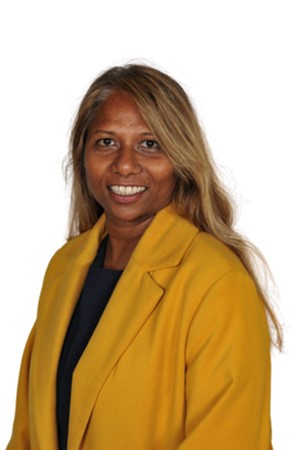
Mrs Jespy Pereira Barker
Head of School - Millbrook Primary School
Attendee - All Meetings
email: jespy.barker@millbrook.herts.sch.uk
Mr Robert Fielden
Co-opted Governor (Local Authority)
email: robert.fielden@millbrook.herts.sch.uk
Staff Governor - Federation
Vacant
Andrew Harling
Co-opted Governor - Bonneygrove Primary School
aharling@bonneygrove.herts.sch.uk
Stacey Perkins
Parent Governor - Millbrook Primary School
Marc Kirby
Parent Governor - Bonneygrove Primary School
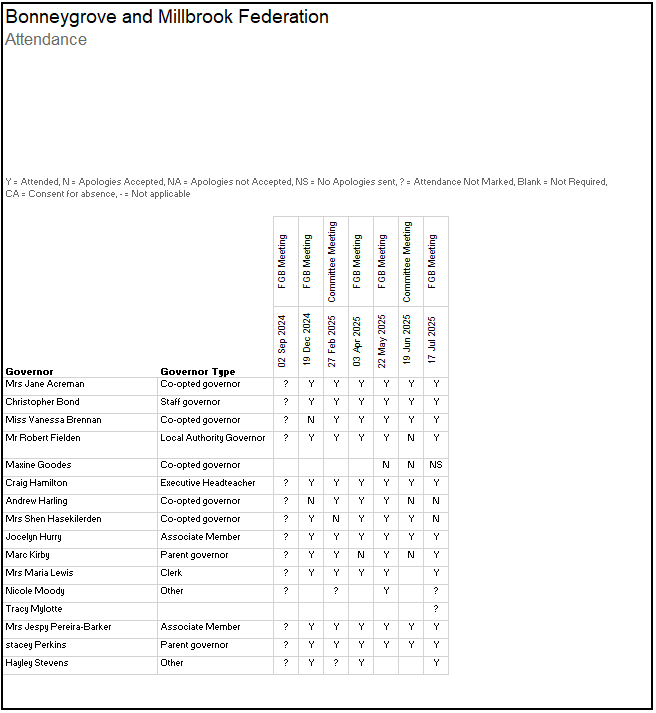
Attendance of Governors Meetings - September 2025-2026
Pecuniary interests
The governing body maintains a current register of pecuniary interests in line with statutory requirements. This is reviewed at least annually and updated as required. At the time of the inspection, no governors have declared any relevant pecuniary or financial interests that would present a conflict with their governance responsibilities.