- Home
- Statutory Information
- Safeguarding at Bonneygrove and Millbrook Primary Federation
- Safeguarding at Bonneygrove and Millbrook Primary Federation
Safeguarding at Bonneygrove and Millbrook Primary Federation
What is Safeguarding?
At Bonneygrove and Millbrook Primary Federation, keeping children safe is our highest priority.
Safeguarding means doing everything we can to make sure children are safe, healthy, cared for and protected from harm. It includes:
- protecting children from abuse, neglect and exploitation;
- protecting children's physical and mental health and development;
- providing help and support as soon as concerns arise;
- keeping children safe at school, at home, in the community and online; and
- taking action so that every child has the opportunity to achieve the best possible outcomes.
Safeguarding is everyone's responsibility.
What does the school have to do?
Schools have a legal duty to safeguard and promote the welfare of children. We follow the Department for Education's statutory guidance, Keeping Children Safe in Education (KCSIE) 2026, as well as Working Together to Safeguard Children 2026.
At both of our schools we must:
Train our staff
All staff receive safeguarding training and regular updates. They are taught how to recognise possible signs of abuse, neglect, exploitation and other concerns and what they must do if they are worried about a child.
Have trained safeguarding leaders
We have a Designated Safeguarding Lead (DSL) and trained deputies who take responsibility for managing safeguarding concerns and working with children, families and other professionals.
Listen to children
Children are encouraged to talk to a trusted adult if they are worried, frightened or uncomfortable about something. We take what children tell us seriously.
Act on concerns
Staff must report safeguarding concerns immediately. We record concerns carefully and take appropriate action. We do not wait for a situation to become more serious before seeking help.
Work with parents and carers
Wherever possible, we work openly and positively with families. Sometimes, however, we may need to share information with Children's Social Care, the police or another safeguarding professional in order to protect a child.
Work with other agencies
Safeguarding children is a shared responsibility. We work with Children's Social Care, health professionals, the police and other services when children or families need additional help or protection.
Recruit people safely
We carry out the required safeguarding and recruitment checks on adults who work or volunteer within our schools and maintain the statutory Single Central Record.
Keep children safe online
Online safety is part of safeguarding. We teach children how to stay safe online and have appropriate systems for filtering and monitoring school internet and technology use.
Take all forms of abuse seriously
This includes physical, emotional and sexual abuse, neglect, bullying, discrimination, child-on-child abuse, domestic abuse, exploitation, harmful sexual behaviour and online harm.
What happens if we are worried about a child?
Our staff are expected to:
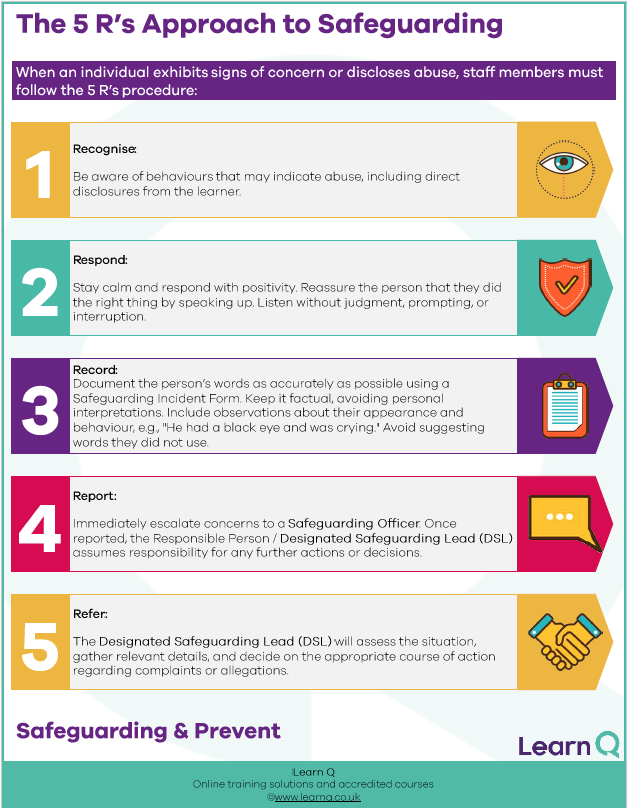
Recognise → Respond → Record → Report
We listen to the child, record the concern and report it to the Designated Safeguarding Lead. The safeguarding team then decides what action is needed.
This might include supporting the child in school, talking with parents or carers, seeking advice from another professional, arranging early support or making a referral to Children's Social Care.
Our decisions will always be guided by one question:
What is in the best interests of the child?
Working Together with Parents and Carers
Parents and carers are an important part of safeguarding.
Please speak to us if something does not feel right or you are worried about your child or another child. You do not need to have proof before sharing a concern.
Equally, please tell us if something is happening at home that may affect your child's wellbeing. We are here to listen, support and help, not to judge.
There may be occasions when the school has a safeguarding duty to share information with other professionals. Where it is safe and appropriate to do so, we will explain this to parents and carers.
Our Commitment
At Bonneygrove and Millbrook Primary Federation, we want every child to:
Feel Safe • Be Heard • Be Valued • Know Who to Talk To • Get Help When They Need It
Safeguarding is not something we do only when there is a problem. It is part of everything we do, every day, to keep our children safe.
Keeping Our Children Safe
At Bonneygrove and Millbrook Primary Federation, safeguarding children is our highest priority.
We are committed to safeguarding and promoting the physical, emotional and mental health, safety and wellbeing of every child at Bonneygrove Primary School and Millbrook Primary School.
Safeguarding is everyone's responsibility, and we work hard to create a culture in which children feel safe, listened to, valued and confident that adults will help them when they have a worry or concern.
Our approach is preventative as well as responsive. This means that we do not simply act when a safeguarding concern arises; we actively teach children how to keep themselves and others safe and work to identify concerns as early as possible.
What is KCSIE?
KCSIE stands for Keeping Children Safe in Education.
It is statutory guidance issued by the Department for Education which explains the legal duties that schools must follow to safeguard and promote the welfare of children.
The current guidance is Keeping Children Safe in Education 2026, which came into force on 1 September 2026.
KCSIE makes clear that:
- safeguarding is everyone's responsibility;
- schools must take a child-centred approach and consider what is in the best interests of the child;
- children should receive the right help at the right time;
- all staff must know how to recognise and respond to safeguarding concerns;
- schools must have clear procedures for concerns or allegations involving adults working with children;
- schools must work effectively with Children's Social Care, the police, health services and other agencies; and
- all staff must read Part One of KCSIE 2026 in full and follow their school's safeguarding policies and procedures.
We operate both schools in accordance with these requirements.
Our Approach to Safeguarding
Across our Federation, we maintain a zero-tolerance approach to abuse.
This includes abuse between children, sometimes referred to as child-on-child or peer-on-peer abuse. We will never dismiss harmful behaviour as "banter", "part of growing up" or something children simply have to tolerate.
Safeguarding can include concerns relating to:
physical abuse • emotional abuse • sexual abuse • neglect • child-on-child abuse • bullying • discrimination • sexual harassment • sexual violence • online abuse • exploitation • domestic abuse • radicalisation • mental health and wellbeing • attendance and children missing education • female genital mutilation (FGM) • honour-based abuse • forced marriage • criminal exploitation • child sexual exploitation • county lines • substance misuse • online safety and any other situation in which a child may be at risk of harm.
We recognise that safeguarding concerns can occur inside or outside school, at home, in the community and online.
Our message to children is simple:
If something worries you, frightens you, makes you uncomfortable or does not feel right – tell an adult. We will listen.
Training Our Staff
Safeguarding is not the responsibility of one person or one team. Every member of staff has a responsibility for safeguarding.
All staff receive safeguarding training as part of their induction before or when they begin working within the Federation. They receive regular safeguarding updates throughout the academic year so that safeguarding remains an active part of everyday school practice.
Staff are trained to understand:
- Keeping Children Safe in Education 2026 – Part One;
- the Federation's Child Protection and Safeguarding Policy;
- how to recognise possible signs of abuse, neglect and exploitation;
- child-on-child abuse and harmful sexual behaviour;
- online safety and emerging online risks;
- domestic abuse and the impact it can have on children;
- mental health as a possible indicator of safeguarding concerns;
- the Prevent Duty and risks associated with radicalisation;
- FGM and other forms of honour-based abuse;
- child sexual and criminal exploitation;
- attendance and children who may be missing from education;
- how to listen and respond appropriately when a child makes a disclosure;
- how and when to record and report a concern;
- whistleblowing and low-level concerns;
- allegations concerning adults working with children; and
- the importance of sharing information appropriately where this is necessary to protect a child.
Our Designated Safeguarding Leads (DSLs) and Deputy Designated Safeguarding Leads (DDSLs) undertake additional specialist safeguarding training appropriate to their roles.
Governors also receive safeguarding training so that they can provide appropriate oversight and challenge and assure themselves that safeguarding arrangements across the Federation are effective.
Working With Parents, Carers and Other Agencies
We believe safeguarding works best when schools, families and professionals work together.
We therefore work closely with parents and carers and, where appropriate, with external professionals including:
Hertfordshire Children's Services • Hertfordshire Safeguarding Children Partnership • Police • Health Services • Social Workers • Family Support Services • Mental Health Services • Early Help and other specialist agencies.
Our work is informed by Working Together to Safeguard Children 2026, the statutory guidance governing how organisations and agencies should work together to help, support and protect children and their families.
The 2026 guidance reinforces the importance of a shared responsibility for safeguarding, inclusive and anti-discriminatory practice, effective multi-agency working and recognising both visible and less visible forms of harm.
Sharing Information to Keep Children Safe
Parents and carers should be aware that there may be circumstances where the school needs to share information with Children's Social Care, the police, health professionals or another safeguarding agency in order to protect a child.
Where appropriate, we will work openly with families. However, the safety and welfare of the child must always come first.
Safeguarding information is handled sensitively and only shared with those who need it for the purpose of protecting or supporting a child.
Safer Recruitment and Visitors
We follow robust safer recruitment procedures when appointing staff and volunteers.
Appropriate pre-employment checks are completed, including Disclosure and Barring Service (DBS) checks where required, and the Federation maintains a Single Central Record of the statutory recruitment and vetting checks.
Visitors, contractors and volunteers are managed in accordance with our safeguarding procedures and are provided with appropriate safeguarding information when entering our schools.
If You Are Worried About a Child
Please tell us.
You do not need to have proof that something is wrong. If something you have seen or heard concerns you, we would rather you share it with us.
Parents and carers can speak to a member of the school's Designated Safeguarding Team or contact the school office and ask to speak privately with a safeguarding lead.
Outside School
If you are worried that a child may be being abused or neglected, you can contact:
Hertfordshire Children's Services: 0300 123 4043
This number can be used by a child or young person, parent, carer or another concerned adult and is available 24 hours a day.
NSPCC Helpline: 0808 800 5000
Adults can contact the NSPCC for advice if they are concerned about a child's safety or wellbeing.
Childline: 0800 1111
Children and young people can contact Childline for free, confidential advice and support.
Police: 101
Contact the police on 101 where a police response is required but there is no immediate emergency.
In an Emergency
If you believe that a child is in immediate danger or a crime is taking place, call 999.
You do not need the school's permission to report a safeguarding concern.
Our Commitment
At Bonneygrove and Millbrook Primary Federation, safeguarding is not simply a policy or an annual training exercise. It is part of the culture of our schools and the responsibility of every adult who works with our children.
We want every child to know:
You have the right to feel safe.
You have the right to be listened to.
You have the right to ask for help.
There will always be an adult in our schools who will listen to you.
We ask our children, staff, governors, parents and carers to work together with us to keep every child within our Federation safe.
Key Safeguarding Guidance
Our safeguarding arrangements are informed by current statutory guidance, including:
Keeping Children Safe in Education 2026 – Department for Education
Working Together to Safeguard Children 2026 – Department for Education
Information Sharing to Safeguard Children and Young People – Department for Education
Hertfordshire Safeguarding Children Partnership procedures and guidance
Our Federation's Child Protection and Safeguarding Policy and other relevant safeguarding policies are available through our website.
Hertfordshire Safeguarding Children -Report Safeguarding Issue
Report concerns about a child or request support
If you're a child or young person being abused – or a worried parent or adult – call us any time on 0300 123 4043.
Call 999 if someone is in immediate danger or a crime is being committed.
Professionals
If you're a professional, make a referral about a child or young person online.
Professionals – make a referral about a child or young person
Call 999 if someone is in immediate danger or if a crime is being committed. Call 0300 123 4043 for urgent out of hours safeguarding support.